

Key takeaways
- A house sale moves in stages: a buyer commits, the deal becomes certain, then transfer. You choose how the buyer is found; transfer runs through a conveyancer, the municipality and the deeds office on every route.
- An auction gives you a date agreed before marketing starts, and on our property auctions the sale doesn’t wait on the buyer’s bond. The trade-off: it’s public, and if bidding doesn’t reach your reserve (the lowest price it can sell for), the house doesn’t sell on the day.
- With an estate agent, offers are often subject to bond approval, so a quick offer isn’t a certain sale until the bank says yes.
- A company that buys houses deals with you directly, but nobody bids against it. Compare its offer with a price guide before you accept.
- Start the paperwork now: the municipal account, the electrical certificate of compliance, your bank’s terms for cancelling the bond, and your spouse’s written consent if you’re married in community of property.
Where the time goes in a house sale
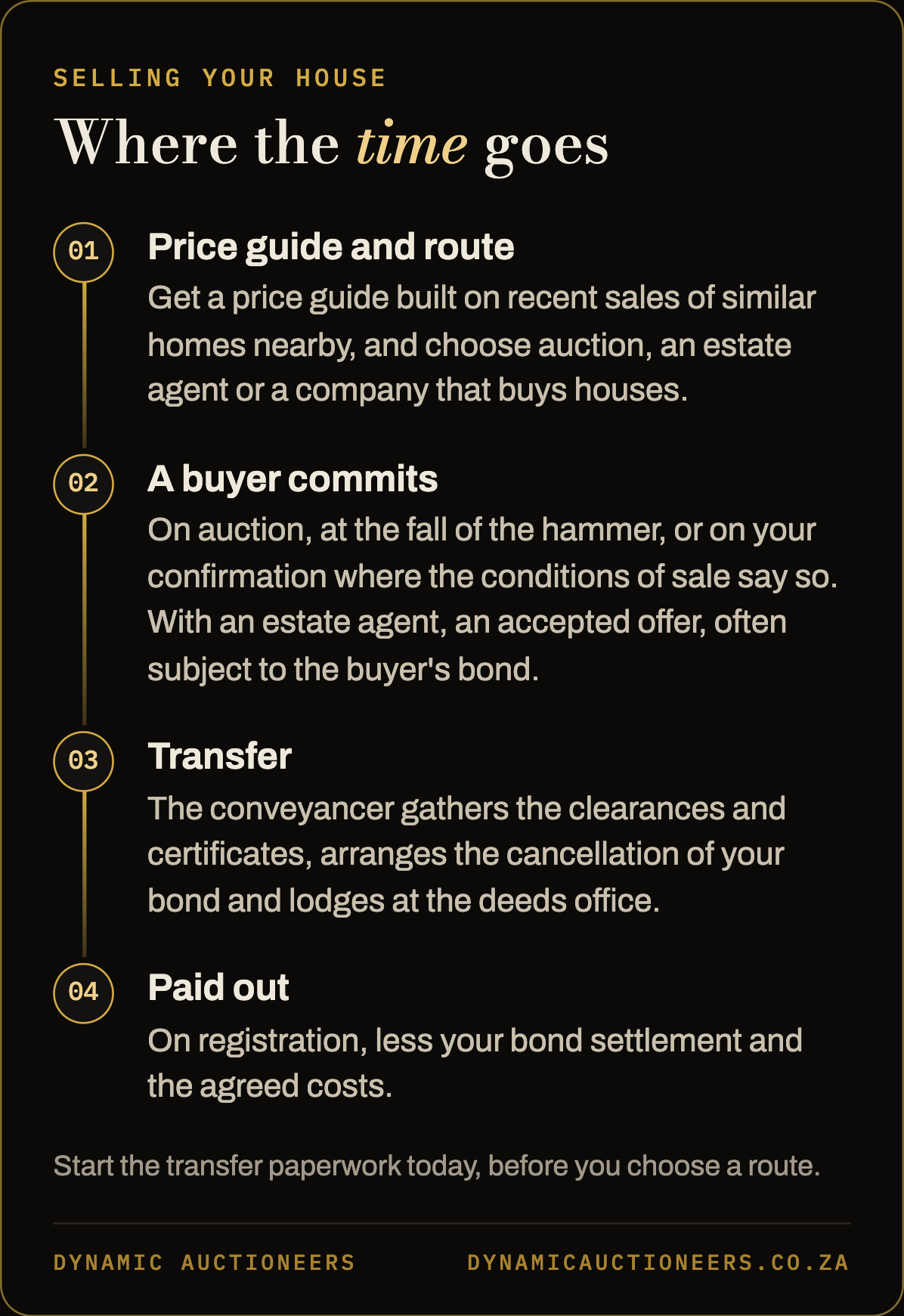
A house sale has stages, and each of them can stall. First, someone has to commit to buying. Then the deal has to become certain, and on a private sale that often means waiting for the buyer’s bank. Then comes transfer: a conveyancer (the attorney who handles transfers) prepares it, gathers the clearances and certificates, arranges the cancellation of your bond and lodges it at the deeds office. You’re paid out when the transfer registers, less your bond settlement and the agreed costs.
No route skips transfer. So the honest answer to “how do I sell my house fast?” is partly about the route you pick, and partly about paperwork you can start before you’ve picked it.
Auction gives you a date, not a guarantee
An auction is the route built around a date. You agree the auction date with us before any marketing starts, so you know your auction day from the start. Bidders register and are vetted before they can bid, and under the Consumer Protection Act a sale by auction is complete when the auctioneer announces it by the fall of the hammer, or in another customary manner.
On our property auctions, the sale doesn’t wait on the buyer’s bond. Bidders who need finance arrange it before the auction. Some auctions work differently and take the highest bid subject to your confirmation within a set period; where that applies, the conditions of sale say so, and the decision in that window is yours, not a bank’s.
That’s the case for auction when time matters. Here’s the other side, and you should hear it before you sign anything:
- It’s public. An open auction is advertised so the general public has a reasonable chance to learn about it. That’s why it doesn’t suit a quiet sale.
- It can fall short. We agree a reserve with you in writing before the auction, and if bidding doesn’t reach it, your house doesn’t sell that day. You can then consider an offer that comes in afterwards, re-list it for a later auction or sell privately, but the market has seen it go unsold.
- It narrows the field when buyers need bonds. First-time and entry-level buyers usually can’t commit before the bank answers. For an ordinary home in a busy suburb, an estate agent may do as well, and we’ll tell you so.
What you’ll pay us is set out in writing before you sign. Our auction or estate agent guide puts the routes side by side on price, costs and privacy.
Estate agent: a quick offer isn’t always a quick sale
An estate agent markets your house until the right offer arrives, and you negotiate with each buyer in turn. Offers are often subject to conditions, usually bond approval or the sale of the buyer’s own home. Until those are met, you have a deal on paper, not a sale you can plan around. If the bond is declined or the deadline passes, the agreement generally lapses and you’re back on the market.
That doesn’t make it the slow route. A well-priced home in a busy suburb can do very well this way. If you go with an agent and speed matters, ask to see the recent sales the asking price is based on. Then read the conditions in any offer before you accept it: how long the buyer has to get bond approval, and whether the offer depends on them selling their own home first.
We sell this way too, through Dynamic Real Estate (a sale like this is called private treaty), so we can talk you through both.
A company that buys houses: you only see its price
A company that buys houses buys the house itself and makes you its own offer. Nobody bids against it, so the price is whatever you and that buyer agree. If certainty matters more to you than price, that can be a fair trade.
Before you accept, ask for the offer in writing, check exactly what you’ll receive and which costs you still carry, and get a price guide from someone else to compare it with. Then you’ll know what you’re trading for the certainty.
The paperwork you can start today
None of this depends on the route, and every conveyancer will need it. Start before you’ve chosen:
- Proof of identity for every registered owner, and the title deed.
- Your latest municipal rates account. The deeds office can’t register the transfer without the municipality’s clearance certificate confirming that rates and service charges on the property have been paid for the period the Municipal Systems Act sets. If there’s a dispute, an estimated reading or a charge you don’t recognise, start on it now.
- An electrical certificate of compliance. The Department of Employment and Labour says a valid certificate must be obtained and provided before the sale or transfer of any property. Book the electrician early, in case something needs fixing first. An electric fence or a gas installation needs its own certificate; our guide to selling property on auction lists them.
- Your bank’s terms for cancelling the bond. In a normal transfer, the bond is settled from the proceeds and cancelled when transfer registers. Tell your bank you plan to sell as soon as you decide, and ask for its notice period and any cancellation charge in writing.
- Your spouse’s written consent, if you’re married in community of property. Neither of you may sell the house, or sign a contract to sell it, without the other’s written consent.
- The body corporate’s details, for a sectional title flat or townhouse. The deeds office won’t register the transfer of a unit without a conveyancer’s certificate that the body corporate has confirmed everything you owe it is paid, or provided for to its satisfaction.
Selling a house you inherited? Our guide to selling deceased estate property covers what the executor needs first.
Price is part of the speed
On any route, a price the evidence doesn’t support costs you time. On auction, a reserve set far above the price guide doesn’t protect you: it gets the house passed in, unsold on the day, in front of every buyer in the market. Our guide to the reserve price shows how to work out yours.
So before you choose a route, ask for a price guide built on recent sales of similar homes nearby, and decide the lowest price you’d accept. It’s much easier to move quickly when you already know your walk-away number.
Which route is fastest for your house?
If you need a date and your likely buyers have finance in place, auction is built for that. If it’s an ordinary home in a busy suburb and you can wait for a buyer’s bank, an estate agent may do as well. If certainty matters more to you than price, a company that buys houses is an option, as long as you’ve compared its offer first.
We sell houses, flats and townhouses on auction anywhere in South Africa from our office in Centurion. Tell us about your house and an auctioneer will call you back. You’re not committing to sell, and you’ll get a price guide and an honest view on whether auction or private treaty suits it.